From November 24 - 26 The ResNRJwater partnership is holding its seventh partner meeting at the headquarters of Emschergenossenschaft and Lippeverband (EGLV) in Essen, Germany.
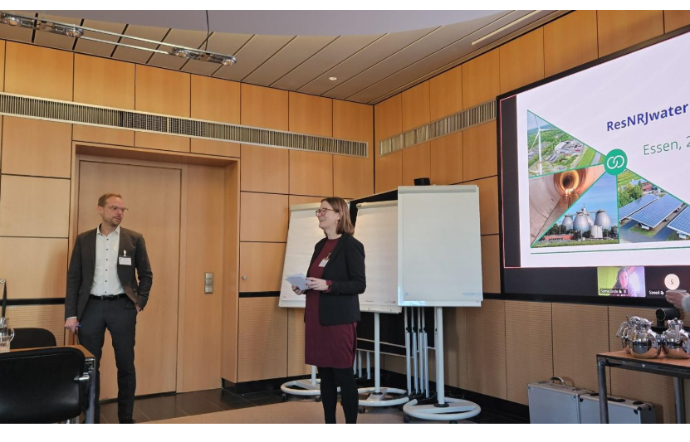
Over three days, the partners are reviewing the status of the pilot plants and working on the project's strategy and policy recommendations. They are also seeing first-hand a region that has changed fundamentally, and keeps changing.
A region shaped by transformation
Dr. Dominik Leutnant (EGLV) welcomed the partners on the first day and reminded them of the host region's history:
"As you know, our region, the Emscher-Lippe region area, has undergone a remarkable transformation over the past decades, particularly in the field of water management. This experience has taught us how important innovation, cooperation and long-term commitment are – values that are also at the heart of ResNRJwater."
He then turned to the project itself: by combining renewable energy generation with intelligent energy management, water management facilities can contribute to the energy transition and the heating transition, while strengthening energy resilience and supporting grid stability.
Annika Kleinschmidt of BDEW (North Rhine-Westphalian section of the German Association of Energy and Water Industries) talked about current water management topics in Germany and North Rhine-Westphalia. She focused on how to get from strategies to implementation.
Where the pilots stand
In the afternoon, the focus moved to the state of the art within the project. Project manager Lisa Schiferle (Lippeverband) gave an update on the overall project status. The pilot partners then reported on their sites: Lippeverband, the Dutch water board HHNK and the Flemish water company Aquafin. In the breaks, the conversations continued. Representatives from Lippeverband, Ruhrverband and Aquafin, for example, compared their plans for battery energy storage at wastewater treatment plants.
Find out more about the pilot plants in the section
Outlook: from the Emscher estuary to a former ironworks
On the second day, the partners leave Essen for KLEM in Dinslaken. Located just before the Emscher flows into the Rhine, it is one of the four largest wastewater treatment plants operated by Emschergenossenschaft (EG). EG is currently investing in new digesters and CHP units, PV installations and a new training workshop there.
Learn more about the visit:
Between the Emscher Estuary and Brussels